Arabic (Oman) · ar-OM
السلام عليكمArabic voice over for Oman
Oman's official voice is Modern Standard Arabic; its everyday voice is Omani Arabic, a Gulf variety with its own regional colour. A spot voiced in Dubai or Riyadh speech reads as foreign to Omanis, and many listeners are not Arabic speakers at all.
- Script
- Arabic, right to left
- Region
- Middle East and North Africa
- Availability
- We cast itnative voices, shortlist for your script
Muscat · national campaigns
A Muscat voice
Cast by region when it matters: a Muscat voice for national campaigns.
Choose a region to see how it differsMap data: Natural Earth, public domain
Oman at a glance
- Speakers
- Arabic is Oman's official language. At the end of June 2026 the population was 5,398,645: 3,063,949 Omanis (56.75 %) and 2,334,696 expatriates (43.25 %).[1]
- Where it is used
- Standard Arabic carries government, news, education and formal corporate work. Omani Arabic is the spoken language across the country, with clear differences between the north and Muscat and the Dhofar region in the south. Dhofar is also home to Modern South Arabian languages such as Jibbali and Mehri; Kumzari is spoken in Musandam.
The short answer
Standard Arabic or Omani Arabic?
Standard Arabic for ministries, news-style films and most e-learning. Omani Arabic for advertising and anything that should sound local. Many campaigns use a Standard Arabic script delivered by an Omani voice with a light local colour.
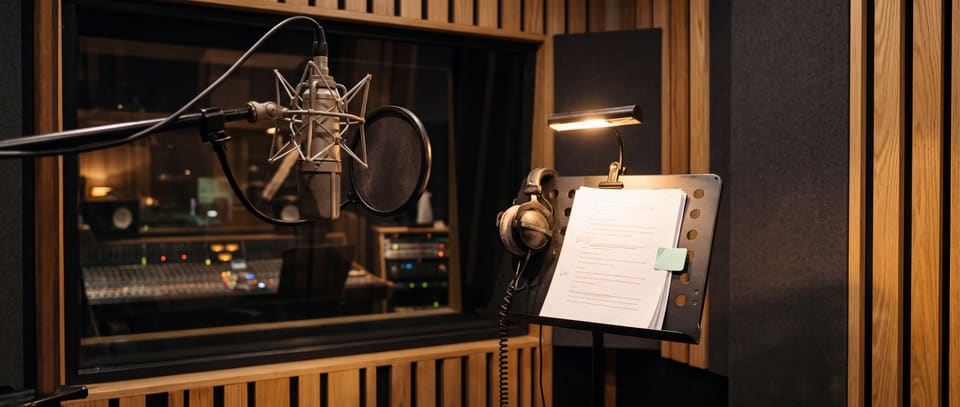
Recorded for Oman
How to choose between Standard Arabic and Omani speech for an audience that is more than four in ten expatriates, with Omani names, money and address settled before recording.
How it works
From brief to final audio.
- 01
Tell us about the project
Share the markets, the script or its estimated length, the usage and the deadline.
- 02
Choose the voice
We send a shortlist of native Omani voices with samples in your tone and notes on accent and register. You choose, and we book.
- 03
Receive the final audio
Edited takes for every language and version, named by language, in the formats your editor or learning platform needs.
Arabic (Oman) vs Arabic elsewhere
How Oman sounds different.
Against Standard Arabic, Omani speech drops case endings, uses its own everyday vocabulary and intonation, and differs from Emirati, Saudi or Kuwaiti Gulf speech in ways Omanis hear at once. The usual choice is Standard Arabic for institutions and e-learning, and an Omani voice in a light colloquial register for advertising.
What the ear picks up
- 01
Accent
Cast by region when it matters: a Muscat voice for national campaigns, a Dhofari voice when the audience is Salalah and the south.
- 02
Register
Arabic addresses men, women and groups with different verb and pronoun forms. Decide whether the script speaks to a man, a woman or everyone before the voice is booked.
Before anyone records
Decide before the booth.
What to settle for Oman before anyone records. It saves a second session.
- 01
Length
Time the Arabic script itself. Fully vowelled Standard Arabic with case endings takes longer to read than a colloquial delivery of the same text, so choose the register before fixing the timing.
- 02
Formal or informal address
Choose masculine, feminine or plural address and keep it through the script. Institutional texts use formal Standard Arabic; advertising may speak directly in Omani forms.
- 03
Names and brands
Give the Arabic spelling of every place and brand name (مسقط Muscat, صلالة Salalah, نزوى Nizwa, صحار Sohar) and say whether English brand names are read in English or adapted.
- 04
Numbers, prices and dates
Prices are in Omani rials, divided into 1,000 baisa: write how each price should be read. Say whether dates follow the Gregorian or the Hijri calendar.
- 05
Script on screen
Arabic script, right to left. Supply the script with the vowel marks needed for names, and check on-screen text where Arabic and English or Western digits share a line.
Example
A line written for Oman.
Example line for a delivery service, written for this page; the Omani colloquial version comes from the voice actor.
من مسقط إلى صلالة، نوصل طلبك في نفس اليوم. والتوصيل مجاني للطلبات فوق خمسة ريالات.
From Muscat to Salalah, we deliver your order the same day. And delivery is free on orders over five rials.
Briefs
Who records in Arabic for Oman.
The briefs this market usually brings, and what each one needs from the voice.
Ministries and public bodies
Information campaigns and explainers in formal Standard Arabic.
Banks, telecoms and retailers
Advertising in Arabic and English, often with an Omani voice for the Arabic version.
Employers and training providers
E-learning and induction for Omani staff and mixed teams.
Tourism and hospitality
Films and guides for Muscat, the interior and Dhofar.
Questions
Arabic (Oman): questions
Standard Arabic or Omani Arabic?
Standard Arabic for ministries, news-style films and most e-learning. Omani Arabic for advertising and anything that should sound local. Many campaigns use a Standard Arabic script delivered by an Omani voice with a light local colour.
Can a voice from the Emirates or Saudi Arabia record for Oman?
For formal Standard Arabic, a well-trained Gulf voice can work. For colloquial advertising, Omani listeners hear the difference: cast an Omani voice.
Should the Oman version also be in English?
Often yes. More than four in ten residents are expatriates, so many campaigns run an English version beside the Arabic one, and sometimes other languages spoken by the expatriate audience.
Can we reuse an Arabic script written for the UAE or Saudi Arabia?
As a starting point, yes; as final copy, no. Have an Omani reviewer replace neighbouring everyday words, local references and currency, and confirm the address forms before the script is timed.
Do Ramadan and National Day spots need a different delivery?
Decide it per campaign with someone in Oman. Seasonal greetings, the level of formality and a calmer pace weigh more in these spots than in everyday retail, so write the greeting into the script instead of leaving it to the voice.
Do campaigns in Dhofar need Jibbali or Mehri?
For most commercial work, Arabic reaches Dhofar. Treat Jibbali or Mehri as a specialist request for community or heritage projects, worded and recorded by native speakers of that language.
Keep exploring
Sources
- National Centre for Statistics and Information (NCSI), population at end of June 2026, via Oman Observer · 2026-06
- NCSI population clock · consulted 2026-11-01
Find the voice for every market.
Tell us what you’re making and where it will be heard. No finished script? Share an outline.
The form asks
- Work emailWhere we send the quote
- Languages and marketspt-BR or pt-PT, es-ES or es-MX
- Your projectLength, where it will be used and your date. The script is optional.
We review your brief, clarify any missing details and confirm the scope, quote and delivery schedule.